

What Does the Check Engine Light Mean?
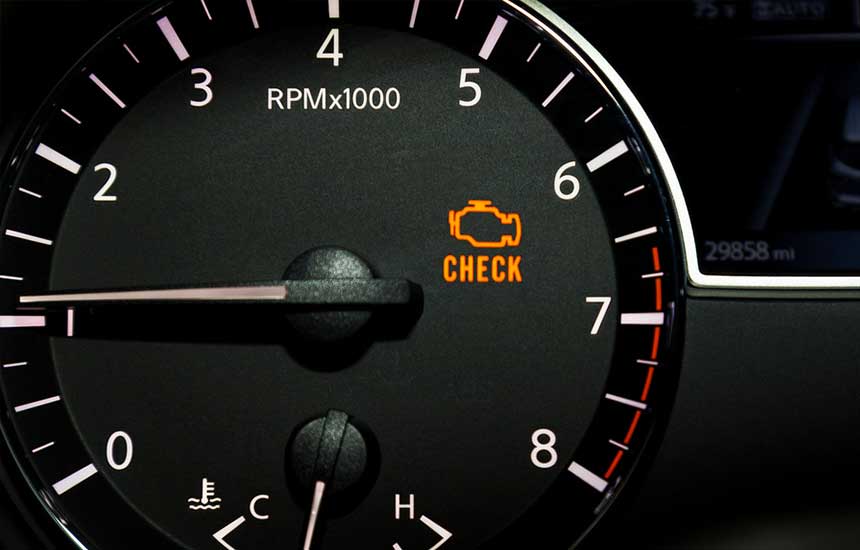
The check engine light means the vehicle’s engine management or emissions monitoring system has detected a condition that requires attention. Possible causes range from a loose fuel cap on some vehicles to ignition problems, sensor faults, or engine misfires.
The light alone cannot identify the failed part. Its behavior, any accompanying warning lights, and the vehicle’s symptoms help determine how urgently the problem needs attention.
1. Check Whether the Light Is Steady or Flashing
A steady check engine light
A steady light generally indicates that the vehicle has detected a fault that needs diagnosis. If the car runs normally and there are no other serious warnings, you may be able to drive a short distance to a repair facility, depending on the vehicle manual and symptoms.
Do not ignore the light simply because the car seems to run normally.
A flashing check engine light
A flashing light can indicate an active engine misfire that may damage the catalytic converter.
Reduce engine load and stop driving as soon as it is safe. If the light continues flashing, the engine shakes, power drops significantly, or unusual noises occur, switch off the engine when safely parked and arrange professional assistance.
Other warning lights, such as an oil-pressure warning or an overheating warning, may require an immediate stop regardless of whether the check engine light is steady.
2. Check the Fuel Cap if Your Vehicle Has One
On vehicles with a conventional fuel cap, a loose or improperly sealed cap can trigger an evaporative-emissions warning.
If you have just refueled:
-
Park safely and switch off the engine.
-
Check that the cap is present and correctly tightened.
-
Inspect it for visible damage.
-
Follow the vehicle manual for proper installation.
Not all vehicles use a conventional fuel cap, and a loose cap is only one possible cause. Do not assume the issue is resolved just because the cap has been tightened.
3. Understand Common Causes
The check engine light may be associated with:
-
Ignition misfires: Worn spark plugs, faulty ignition coils, or other ignition problems.
-
Fuel-system issues: Problems affecting fuel delivery or mixture.
-
Emissions-system faults: Issues involving the evaporative-emissions system or catalytic converter.
-
Sensor faults: Incorrect readings from sensors used by the engine management system.
-
Air-intake problems: Air leaks or faults affecting measured airflow.
These are possibilities, not diagnoses. Replacing a sensor simply because a code mentions it can waste money if the real cause is a wiring fault, air leak, or another component.
4. Use an OBD-II Scanner to Read Diagnostic Codes
Many modern vehicles support onboard diagnostic code reading through an OBD-II-compatible scanner, although access and functions vary by vehicle and market.
A basic workflow is:
-
Park safely and identify the diagnostic connector using the vehicle manual.
-
Use a scanner compatible with the vehicle.
-
Read and record the stored diagnostic trouble codes.
-
Note any accompanying symptoms and freeze-frame data if available.
-
Consult reliable service information for the specific code and vehicle.
A diagnostic code identifies a detected condition or circuit issue. It does not automatically prove which component must be replaced.
Avoid clearing codes before recording them. Clearing them can remove useful diagnostic information and does not repair the underlying fault.
5. Decide Whether You Should Keep Driving
Use the symptoms as well as the warning light.
Stop as soon as safely possible and seek assistance if:
-
The check engine light flashes persistently.
-
The engine shakes severely or loses substantial power.
-
The temperature warning indicates overheating.
-
The oil-pressure warning appears.
-
You smell fuel strongly, see smoke, or hear serious mechanical noises.
If the light is steady and the vehicle behaves normally, check the owner’s manual and arrange diagnosis promptly. The appropriate response depends on the model, fault, and symptoms.
6. Avoid These Common Mistakes
-
Ignoring a flashing warning light.
-
Replacing parts based only on a diagnostic code.
-
Disconnecting the battery to hide the warning.
-
Clearing codes before recording them.
-
Assuming a vehicle is safe to drive because it still starts.
-
Continuing to drive with overheating or low oil pressure.
Frequently Asked Questions
Can I drive with the check engine light on?
Sometimes, if it is steady, the car behaves normally, and the owner’s manual permits it. A flashing light or serious symptoms require a more cautious response.
Will a loose gas cap turn on the check engine light?
It can on vehicles equipped with a conventional fuel cap and an evaporative-emissions monitoring system. It is not the only possible cause.
Does an OBD-II code tell me exactly what is broken?
No. Codes narrow the diagnostic possibilities. Additional checks may be needed to identify the root cause.
Will the check engine light turn off by itself?
Some intermittent faults may stop triggering the light after the system completes its monitoring checks, but the stored code may remain. Do not rely on the light disappearing as proof that the problem has been fixed.
Final Advice
Treat the check engine light as a diagnostic warning, not a parts-replacement instruction. Check whether it is steady or flashing, watch for serious symptoms, record diagnostic codes, and use vehicle-specific service information to determine the cause.