

Why Basil Often Becomes Tall Instead of Bushy
A basil plant can look healthy while growing one long central stem with only a few leaves near the top. This usually happens when the plant is allowed to keep extending upward without regular pruning.
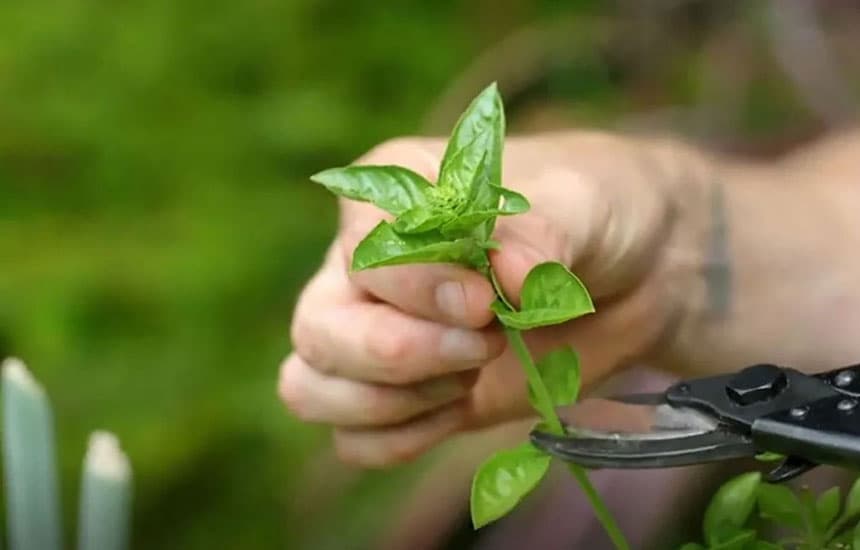
Basil responds well to cutting above a leaf node. The small growing points at that location can develop into side branches, giving the plant a wider shape and more places to produce leaves.
The important part is knowing where to cut. Removing random leaves from the bottom will not encourage the same branching response.
Find the Right Place to Cut
Look along the main stem for a pair of leaves growing opposite each other. The point where those leaves attach to the stem is called a node.
New side shoots can develop from the growth points near that node.
Use clean, sharp scissors or pruning snips. Avoid crushing the stem with dull blades.
Step 1: Wait Until the Plant Is Established
A very small basil seedling needs time to develop roots and several sets of true leaves. Pruning too early can slow its establishment.
Once the plant has several healthy leaf pairs and is actively growing, you can begin light pinching.
Do not use a fixed height as the only rule. A compact plant grown in a bright location may be ready earlier than a tall, weak plant grown in low light.
Step 2: Cut Just Above a Leaf Pair
Choose a healthy stem and locate a pair of leaves. Make your cut slightly above that pair, leaving the node and its leaves attached.
Avoid cutting directly through the node. The goal is to preserve the growth points below the cut.
After pruning, the plant may begin producing two side shoots near the remaining leaf pair. As those shoots grow, they can be pruned in the same way to encourage additional branching.
Step 3: Do Not Remove Too Much at Once
Light, regular pruning is usually better than cutting a young plant back aggressively.
As a practical starting point, remove only a portion of the active growth at one time. Leave enough healthy foliage for the plant to keep producing energy.
If the plant is already weak, pale, or stressed from dry soil, heat, or poor light, correct those conditions before heavy pruning.
Step 4: Remove Flower Spikes When Growing Leaves Is the Priority
Basil produces flower spikes as it matures. If your goal is a steady supply of leaves, pinch off developing flower spikes before they open.
You do not need to remove every flower if you want seeds or enjoy the flowers for pollinators. The choice depends on whether leaf production or flowering is your priority.
Step 5: Give the Plant Enough Light and Space
Pruning cannot compensate for poor growing conditions.
Basil generally grows best with strong light, warm conditions, and soil that drains well. A crowded plant may develop weak stems and leaves that stay damp for too long.
If several plants share a pot, make sure they have enough room for air to move between them. Water when the upper layer of growing medium begins to dry, rather than keeping the soil constantly saturated.
What to Do With the Cuttings
Healthy basil tips can be used in cooking or rooted in water to start new plants.
For propagation, remove the lower leaves from a suitable cutting and place the bare lower stem in clean water. Keep the remaining leaves above the waterline and change the water if it becomes cloudy.
Not every cutting will root successfully. Once roots have developed, move the cutting into a suitable potting mix and keep the medium evenly moist while it establishes.
Common Basil Pruning Mistakes
| Mistake | Why it causes trouble |
|---|---|
| Cutting below all leaf pairs | Removes useful growing points |
| Using blunt scissors | Can crush the stem |
| Removing too much foliage | Reduces the plant’s ability to recover |
| Pruning a severely stressed plant | Adds stress before growing conditions are corrected |
| Ignoring flower spikes | Allows the plant to shift toward flowering and seed production |
Frequently Asked Questions
Can I cut basil all the way back?
A healthy, established plant may tolerate substantial pruning, but cutting away nearly all its leaves can slow recovery. Leave healthy foliage and avoid severe pruning on a weak plant.
How often should basil be pruned?
Check the plant regularly during active growth. Prune when stems become long enough to cut above a healthy leaf pair, rather than following a rigid weekly schedule.
Should I remove the large leaves at the bottom?
Remove yellow, damaged, or diseased leaves when necessary. However, routine pruning for a bushier shape should focus on stem tips and nodes, not simply stripping the lower leaves.
Can basil grow back after flowering?
Yes. Flowering does not automatically mean the plant is finished. You can remove flower spikes and continue caring for the plant, although growth may change as it matures.
Final Advice
For a fuller basil plant, focus on the stem tips rather than randomly removing leaves. Cut above healthy leaf pairs, allow side shoots to develop, and avoid taking too much foliage at once. Good light and suitable watering remain just as important as pruning.